 blogGet in touch
 Writing is an important part of any business. Whether you’re writing ads, copy for a website, or blog posts to increase your SEO, you will most likely run into writing at some point.
Writing is an important part of digital marketing. This article is about writing blog posts, and how it can help your business.
How can writing blog posts benefit your business?
Blogs offer you the opportunity to continually expand your content and searchability on search engines, while keeping your website nice and tidy.
Well-written articles should mean good/better SEO value, which should mean increased organic search results. Increased organic search results should mean more people are finding their way to your website.
And that means that you have more opportunities to obtain new leads. And you have content that can keep people coming back.
Blogs also offer you the opportunity to talk about your products & services, and to share your expertise. People are always looking for content on the web.
You want even a small percentage of them to find their way to your website, and potentially become new clients (or promoters). The solution? Well-written, engaging, and informative blog posts.
In this article, you’ll learn about:
- How to write a good blog post.
- Tools to help in your writing quest.
- Design to accompany your stellar article.
1. How To Write Good
While this article is about how to write a good article, it’s also directed at businesses owners and why good writing can be good for your business.
But writing, especially good writing for SEO purposes, takes a lot of time and effort. As a business person, you may not have the time it takes to write, your time would be better used doing other things.
For this reason, delegating your writing tasks to others can be the best thing to do for many business owners.
If that’s you, then you should consider hiring a good copywriter or content manager to help you. How much and how often you pay them depends on how good of articles you want, what your budget is, and how long you’d like to keep them onboard. There are a number of sites where freelancers look for work.
There are popular sites like Upwork and Guru, as well as more skill-specific sites like Textbroker, Contently, Skyword, and Newscred (all for writing).
You or your HR can use these sites to scout out and recruit writers or content managers, & explore appropriate pricing.
Learning how to write well takes time and practice, and probably isn’t something the novice will master right away.
Whilst having rigid and definite rules, writing is also extremely flexible, and gives itself to various writing styles - both for the individual writer, and for the type of writing being done.
A good vocabulary is extremely important. That doesn’t mean to go all crazy and continuously use words that most people are unfamiliar with just to show off your new skills.
Moderation is important in the words used, because you want the average person to understand clearly what you’re saying.
If you’re looking for the meaning of a certain word, the Oxford Dictionary can be of great help, or the ever-popular Merriam-Webster Dictionary as well.
Sometimes you have a word in mind, and you want something that’s either similar to it or the opposite of it, but you can’t think of what it might be.
Don't let that one word be a source of writer’s block. If you’re looking for a synonym (a word that is similar to another) or for an antonym (a word that is the opposite of another) Thesaurus.com can probably get you what you need.
When it comes to the finer points of grammar, there’s a great deal to get to know (not necessarily to master, but to be familiar with at least).
Things like tenses, which type of punctuation to use, contractions, passive voice vs active voice, word classes (parts of speech), and more.
There are sources online to help you navigate these dangerous waters. The US government, for example, has a site to help people understand plain English language.
An all-around great source for quizzing your English skills, and learning more grammar is GrammarBook.com - you can even watch grammar videos! If you want to up your writing even more, there are blogs out there all about writing business English.
There’s other things to consider as well, such as the flow of your words. The use of alternating short, medium, and long sentences (but not run-on sentences) is important for rhythm and flow.
As well as sounding natural and not robotic, etc. Consider using the Wordpress plugin YOAST to judge the SEO value and readability of your article.
There are also some general guidelines to keep in mind when writing. For example:
- Use your focus keyphrase word or words often enough within the article. Longer keyphrases will be harder to rank for than shorter ones. Yoast will calculate your keyphrase density using a number of different factors, including the length of your keyphrase (longer ones are preferred). They say you’ll need to use your longer keyphrases less than your shorter ones in the text. Using Yoast will tell you how many times you’ve used your keyphrase and how many times you should use it.
- Try to focus on long-tail keywords. Keywords are single words that you want your article to rank for. Keyphrases are phrases that you want your article to rank for. Slightly different, but both are important for how Google understands your text.
- Use the active voice in most cases. The active voice is important for readability as it uses less words than the passive voice, is in a logical sequence, and gets directly to the point. Yoast recommends using the passive voice for less than 10% of your sentences.
- Don’t use consecutive sentences. Mainly, don’t start 3+ sentences in a row with the same word.
- Try to keep paragraphs below 150 words.
- Try to keep sentences below 20 words.
- Use bullet points & numbered lists.
Always have your spell check on, and preferably some sort of grammar check as well. Most word processors have at least a spell checker.
Grammarly is a great extension tool for Google Chrome, but be aware that it may not work directly with your word processor or with Google docs.
You might have to do some copy/pasting to check your article using the Grammarly tool. There are other similar tools available as well. We’ll be discussing another tool called Yoast SEO later in this article.
2. What To Write About
THAT is the million dollar question. Ok, maybe not quite a million dollars. Maybe not anywhere close to that, but it’s STILL a very important question.
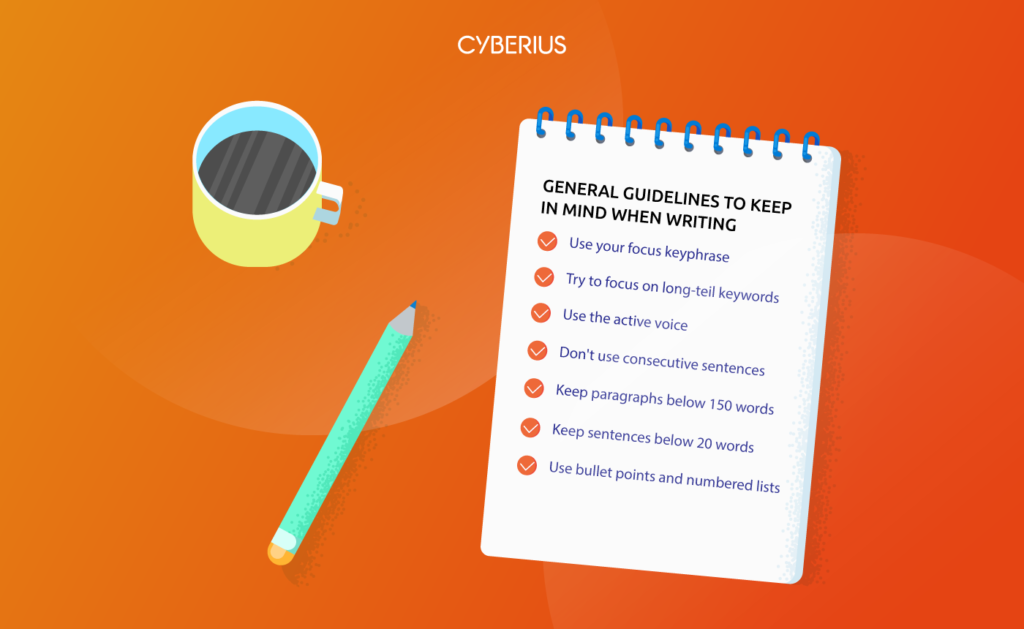
Figure Out The Topic
Ultimately, it’s up to you as the writer. It is highly advised to use a tool such as Ahrefs to find topics that have good organic search volumes in Google.
You need to find keywords and keyphrases that have high monthly searches, that are in a niche, and that you are eligible to rank for within Google’s top 10 pages. Your eligibility is determined by your site’s Domain Rating.
Other things to consider which should influence your decision include:
1. What industry is your business in, and what (if any) niche do you fill? It’s important to write about topics that your audience will find interesting, helpful, and/or insightful.
Something they’re likely to appreciate, share, & want more of.
2. Is your topic already written about online? If so, write it better - give better sources, give more tips, write it for your audience, etc.
3. Consider doing market research on profitable topics related to your business.
4. Consider answering a frequently asked question, or creating a FAQs article.
5. You should definitely consider writing about a current hot topic, so long as you can relate it to your audience & business.
Find Good Keywords
If you want your article to rank organically in the SERPs (Search Engine Results Pages), then you need good and relevant keywords & keyphrases.
You’ve got a number of options for keyword research at your disposal, including:
- Google Keyword Planner (Requires a Google Ads account - free to use the planner)
- Keyword Tool (Free)
- Ahrefs (Pay)
And if neither of those will do, then here’s 10 Free Keyword Research Tools (That CRUSH Google Keyword Planner). I think that ought to be enough keyword research resources for now, and of course there are others out there as well.
Figure Out Your Article Layout
This can be an important step in beginning your article. It’s basically making a draft with the keyword subheadings you’ll be using to logically lay out your article.
Once you’re done with that, simply fill in each section at a time. This could even help reduce the chances of writer’s block.
It also helps readers easily skim over your article to get the gist of it, and to find what they’re looking for quickly. Also, using lists and bullet points once in a while is good.
But this should take some diligent effort. Don’t just make your subheadings whatever you want them to be.
Use an SEO tool to find keywords and keyphrases that rank well and will give a logical layout to your article. Combine both long and short tail keywords. Figure out which ones should be H1, H2, H3, H4, etc.
The H1 tag is reserved for your title within the article at the top of the page. H2 tags should be used for each new section, H3 tags for subsections within H2s, & H4 and on down for lower and lower subsections.
Each ‘H’ tag should be applied to the correct sub-headings, all be logically laid out, and all have been determined based on their SEO value.
3. SEO And Yoast
SEO stands for Search Engine Optimization, and it’s pretty important for most - if not all - public websites. That is if you want people to notice your site.
It consists largely of having the right keywords and phrases in the right places in your article or website.
But there are other factors as well, such as having trustworthy websites with Do-Follow backlinks to your site.
A Do-Follow link means web-crawlers are invited to travel to the link and index it; Whereas a No-Follow link blocks spiders from following, & gives no SEO juice to your website.
Also, good writing and a well laid out article can be taken into consideration as well. As well as things like page loading time.
Yoast is a special Wordpress plugin that helps you with an SEO score and a readability score. Simply plug your article into Wordpress after the plugin is installed, and follow the instructions.
The readability score shouldn’t be taken too strictly, but do try to follow it within reason. It’s a great tool to help make sure your article is pristine and easily searchable online.
Note: Google (the most popular search engine) has been known for changing its algorithm and not telling the general public how to comply. So SEO is not necessarily a clear black and white issue. That said, many have put in long hours to test the algorithms and see what works & what doesn’t. Also, it’s evident that Google & its affiliated platforms (like Youtube) have become increasingly politicized (leaning heavily left). It’s no longer a place for everyone to be treated equally. Conservative channels may find themselves hurting regardless of good SEO.
4. How Long Should A Blog Post Be?
Hmmm, you have asked a hard question. But fear not, there is an answer (you may not like the answer, but it is an answer nonetheless).
In my opinion, there’s no hard-set rule for how long an article should be. And length can even depend on what kind of article you’re writing. Is it a report? A technical post? An entertainment piece? An informative article? It all depends.
However, there are some general suggestions concerning article length. According to an article by CopyExpress, the bottom line is to get your point across, whether it takes you 4,000 words or 400.
Google apparently will count content as too thin if it’s 200 characters. And generally speaking, the more words the better - as they contain more (hopefully) valuable information and resources.
According to the article, 2,416 words was the average word count of top ranking searches. With that in mind, don’t expect your visitors to read through your entire 2,000+ words.
For this reason, clear structuring with subheadings, lists, & bullet points are very important, so that people can easily find what they’re looking for.
Graphics and GIFs, etc. can also help to break up the text and make it visually appealing. They can also work as graphic aids to the reader, and they have SEO value with the meta information.
Our general guidelines for a while here at Cyberius has been between 800 - 1,200 words (but I sometimes blow right past that).
This article from January of last year gives some more insightful data about word count. The general consensus seems to be that longer word counts that are comprehensive on the subject seem to do better (usually).
BUT, you can do well with shorter articles (but not too short). Just make sure that quality is more important than quantity. Cornerstone articles, which should be your best and fullest articles, will probably be longer than your normal content.
You want to give your readers a reason to stay longer, share your content, and come back again. Speaking of quality, it’s not all about keywords, links, and layouts… design is important too!
Note: in the CopyExpress article, they have a subheading with the 9 second goldfish/average reader’s attention myth. Although they explain it’s a myth in the text body, a skimmer may miss this and take it as fact.
5. Design Matters
Design matters in your article. A good design that matches your overall website relates each article back to you, and makes it more interesting to read.
Now you don’t necessarily NEED a design, but generally speaking it’s a good idea. Even if you do nothing but write, that’ll still be seen as your design, your article style, even if it’s really bad. So pay attention to design.
The design of your article can encompass multiple aspects. We’ve already talked about the layout - subheadings, bullet points, lists, etc.
That’s a part of your article’s design. The fonts and font sizes you use also incorporate part of your design - just make sure it’s easily readable and not weird.

Images can make your content much more engaging, and also act as visual aids. More importantly, images have the ability to contain meta information which is searchable on Google, and thus they’re good for your site’s SEO.
Conclusion: Writing a good blog post takes time. How much time depends on your writing experience, research skills, knowledge of the subject, & your dedication. Writing blog posts can be worthwhile if done right. It can help increase your SEO so your website can more easily grow organically. I hope you found this article on how to write a blog post in 5 steps helpful. And hopefully, you see how it can be an effective tool for your business growth.

Happy writing!
Elijah, from the Cyberius team.